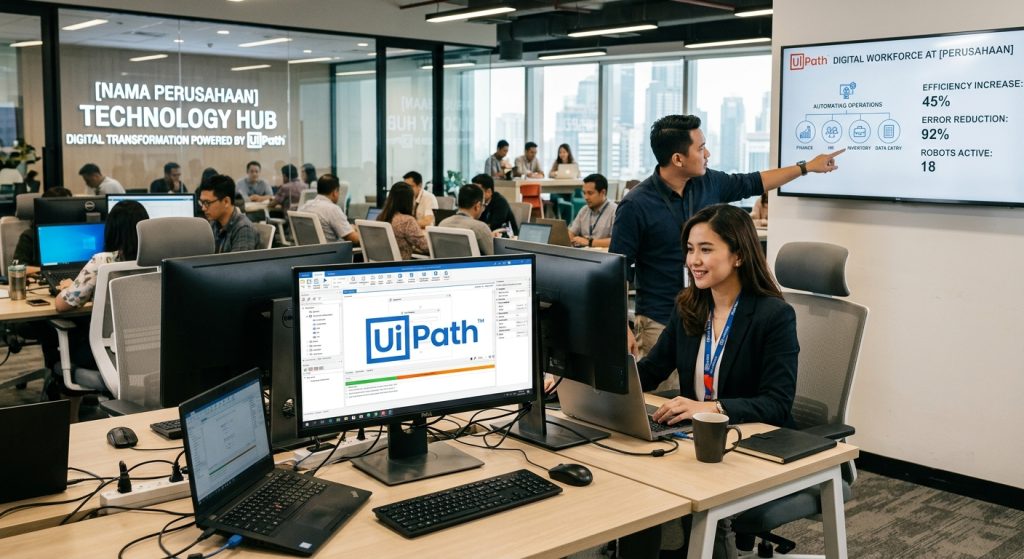
The rapid development of digital technology is changing the way businesses operate. Companies today are expected to provide faster services, process information accurately, and improve productivity while keeping operational costs under control. As business processes become increasingly complex, organizations need innovative technology that can help employees work more efficiently. One technology that has become increasingly important in digital transformation is UiPath.
Understanding UiPath Technology
UiPath is a leading automation platform that enables businesses to automate repetitive tasks and improve business processes through Robotic Process Automation (RPA). By using software robots, companies can automate routine activities that previously required employees to perform the same steps repeatedly. This allows employees to focus on more strategic, creative, and valuable responsibilities.
UiPath is a technology platform designed to help organizations create, manage, and operate automated business processes. One of its main technologies is Robotic Process Automation, commonly known as RPA.
RPA uses software robots to interact with applications and digital systems in a way that can replicate certain human actions. These robots can open applications, enter information, move data between systems, read documents, generate reports, and perform other repetitive tasks based on predefined workflows.
For example, imagine a company that receives hundreds of invoices every week. Without automation, employees may have to open each invoice, check the information, enter the data into an accounting system, and create reports manually. This process can take many hours and may result in errors.
With UiPath, these repetitive activities can be automated. A software robot can help process information according to predefined rules, reducing manual work and allowing employees to concentrate on more important activities.
How UiPath Supports Business Automation
The main strength of UiPath is its ability to automate repetitive and rule-based processes. Businesses can identify processes that consume significant amounts of employee time and determine whether they are suitable for automation.
A typical automation workflow begins by identifying a business process that needs improvement. The company then defines the steps, rules, and information required to complete the process. Using UiPath, an automated workflow can be designed to perform these steps.
For instance, an employee may normally need to collect information from emails, copy the information into a spreadsheet, enter it into a business application, and send a confirmation email. Instead of completing these steps manually every time, UiPath can automate parts of the workflow.
This can make business processes more consistent and reduce unnecessary manual activities.
Improving Business Efficiency
One of the biggest advantages of UiPath is its potential to improve operational efficiency. Repetitive tasks can consume a significant amount of working time, especially in organizations that process large volumes of information.
Automation can help reduce the amount of manual work required for these processes. Software robots can perform predefined tasks consistently, allowing business operations to become more organized.
For example, a company may use automation to process customer information, update databases, generate routine reports, or organize documents. Employees no longer need to spend most of their working hours performing repetitive activities.
Instead, they can use their time to analyze information, solve problems, communicate with customers, and develop new ideas.
Reducing Human Errors
Manual data processing can sometimes result in mistakes, particularly when employees have to perform repetitive activities for long periods. Incorrect data entry, duplicated information, or missed steps can affect business operations.
UiPath automation can help reduce errors in processes that follow clear rules and procedures. Once an automated workflow has been properly designed and tested, the software robot can repeatedly follow the same instructions.
This consistency can be particularly useful in processes where accuracy is important, such as data entry, document processing, reporting, and information transfer.
However, automation does not eliminate the need for human supervision. Businesses still need employees to design workflows, monitor automation, handle exceptions, and make important decisions.
Increasing Employee Productivity
Technology should not simply be viewed as a replacement for human workers. Instead, automation can help employees spend more time on activities where human skills are most valuable.
Employees are often responsible for both routine administrative work and strategic responsibilities. When repetitive tasks take too much time, employees may have less opportunity to focus on creative thinking and problem-solving.
UiPath can help shift this balance by automating suitable routine processes. Employees can then focus on activities such as customer relationships, business analysis, planning, innovation, and decision-making.
This creates a more productive working environment where technology and people can work together.
UiPath Applications Across Different Departments
UiPath can be used in many different areas of an organization.
Finance
Finance departments often manage large amounts of financial information and documentation. Automation can support processes such as invoice processing, data entry, report preparation, and reconciliation activities.
Human Resources
Human resources teams handle employee information, documents, and administrative processes. UiPath can help automate repetitive activities related to employee data management, document processing, and routine administrative workflows.
Customer Service
Customer service departments receive large amounts of information from customers every day. Automation can help organize information, update systems, and perform repetitive administrative tasks, allowing customer service teams to focus more on customer needs.
IT Operations
IT teams can also benefit from automation. Repetitive system-related activities, data processing, and routine workflows can potentially be automated to help IT departments operate more efficiently.
Sales and Marketing
Sales and marketing teams frequently work with customer data, reports, and business information. Automation can help organize data and perform repetitive administrative tasks, giving employees more time to focus on customers and business strategies.
UiPath and Artificial Intelligence
The future of business automation is becoming increasingly connected to Artificial Intelligence (AI). While traditional RPA focuses primarily on structured and rule-based tasks, intelligent automation can combine automation with technologies that help systems process more complex information.
The combination of UiPath automation and AI can create opportunities for businesses to automate processes involving documents, unstructured information, and more complex workflows.
For example, intelligent document processing can help organizations handle information contained in documents. Instead of requiring employees to manually review every piece of information, technology can assist with extracting and organizing relevant data.
This development demonstrates how automation is evolving from simple task automation toward broader intelligent business processes.
UiPath as Part of Digital Transformation
Digital transformation is not simply about purchasing new software. It involves changing the way organizations operate and use technology to achieve business goals.
UiPath can become part of a broader digital transformation strategy by connecting automation with existing business systems and processes.
Companies can begin with simple repetitive processes and gradually expand automation to other areas. This approach allows organizations to learn from their automation projects, improve workflows, and identify new opportunities.
Successful digital transformation requires more than technology. Businesses also need clear objectives, employee involvement, appropriate processes, security considerations, and continuous monitoring.
Why Businesses Should Consider Automation
Competition in the modern business environment continues to increase. Customers expect fast responses, accurate information, and efficient services. At the same time, businesses need to manage resources effectively.
Automation can help organizations respond to these challenges by improving the efficiency of repetitive processes.
Instead of spending valuable working hours on routine activities, employees can focus on higher-value tasks. Businesses can also gain greater consistency in processes and improve their ability to handle growing workloads.
The goal is not simply to automate everything. Businesses should identify the processes where automation can provide meaningful value.
The Role of Technology Partners
Implementing automation successfully often requires careful planning. Businesses need to understand their existing processes, identify suitable automation opportunities, design workflows, test them, and monitor the results.
A technology partner with knowledge of automation can help organizations evaluate their processes and develop appropriate solutions.
For an IT company such as PT. Ichiru, UiPath can be part of a technology-focused approach to helping businesses explore automation opportunities. By understanding a company’s specific needs, automation solutions can be designed to support business processes rather than simply introducing technology without a clear purpose.
The most effective automation strategy is one that connects technology with real business objectives.
Preparing for the Future with UiPath
The future of work will continue to involve collaboration between people and technology. Automation, AI, cloud computing, and data analytics are creating new opportunities for businesses to improve their operations.
UiPath represents an important part of this technological development because it provides tools for organizations to automate processes and build more efficient workflows.
Companies that begin exploring automation today can develop valuable experience in identifying processes, managing digital workflows, and integrating technology into everyday operations.
As automation technology continues to evolve, businesses will have more opportunities to create smarter and more connected working environments.
Conclusion
UiPath technology provides businesses with a practical approach to improving efficiency through automation. By automating repetitive and rule-based processes, organizations can reduce manual workloads, improve consistency, and give employees more time to focus on valuable activities.
From finance and human resources to customer service, IT, sales, and marketing, automation can be applied to many areas of modern business. When combined with Artificial Intelligence and other digital technologies, UiPath can support organizations as they move toward more intelligent and efficient operations.
However, successful automation depends on more than technology alone. Businesses need clear goals, well-designed processes, proper implementation, employee involvement, and continuous improvement.
As digital transformation continues to shape the business world, UiPath can become an important tool for companies looking to work smarter and prepare for the future. Automation is not simply about replacing manual tasks—it is about creating better ways for people and technology to work together.
For modern businesses, the question is no longer whether technology will change the workplace. The more important question is how businesses can use technology effectively to create a faster, smarter, and more productive future.