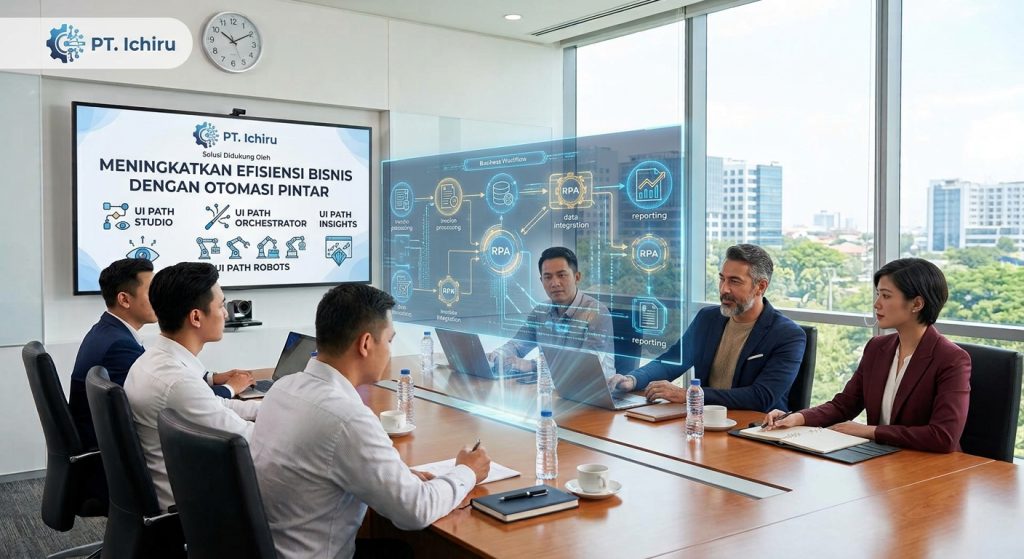
Technology is changing the way companies work. As businesses grow, they must process more data, handle more customers, manage more documents, and complete more daily tasks. If these activities are performed entirely by employees, companies can spend significant amounts of time on repetitive work.
This is why UiPath Automation has become an important part of digital transformation for many large organizations.
UiPath enables businesses to automate repetitive and rule-based processes using Robotic Process Automation (RPA), AI, and workflow automation. Instead of employees spending hours on repetitive administrative tasks, software robots can perform suitable processes quickly and consistently.
But does automation really provide significant benefits?
The answer can be seen from companies that have already implemented UiPath.
DHL: Hundreds of FTE Workloads Handled by Robots
DHL Global Forwarding, Freight is one example of a major company using UiPath to improve its operations.
DHL implemented UiPath as part of its digital transformation strategy to improve finance and logistics processes across its Global Service Centers.
The results were significant.
According to UiPath’s customer case study, DHL Global Forwarding, Freight deployed more than 80 UiPath-based robots in less than one year. The workload equivalent to approximately 300 full-time employees was being handled by robots.
In one pilot process, 15 out of 30 employees were able to move away from manual work and focus on higher-value activities. DHL also achieved a complete return on investment for that pilot in just one month.
This demonstrates an important benefit of automation:
Automation can help employees spend less time on repetitive processes and more time on valuable business activities.
Deloitte: More Than 4 Million Labor Hours Saved
Another major example is Deloitte, one of the world’s largest professional services organizations.
Deloitte implemented UiPath to automate internal processes across its global operations. Areas included customer invoicing, HR onboarding, and HR benefits processes.
The results show the potential of large-scale automation.
Deloitte has automated more than 600 processes and achieved more than 4 million cumulative labor hours saved according to UiPath’s customer story. The company also has more than 4,000 automations.
This is an important lesson for companies considering automation.
A single automation may save a small amount of time. However, when hundreds of processes are automated across an organization, the accumulated benefit can become extremely significant.
EDP Global Solutions: 220,000 Hours Saved
EDP Global Solutions also demonstrates how automation can be scaled across an organization.
The company began an ambitious RPA program with the goal of improving productivity and efficiency.
According to UiPath, EDP Global Solutions has automated more than 450 processes and saved more than 220,000 hours of manual work. It also successfully implemented 85 automations during its first 12 months.
This shows that UiPath is not only useful for one department.
When a company establishes an effective automation strategy, automation can expand across multiple business processes.
Clariant: Automating Invoice Processing
Automation is also useful in manufacturing and financial administration.
Clariant, a global specialty chemicals company operating in 53 countries, used UiPath to improve invoice and shipping processes.
In its pilot region, approximately 50% of invoices were processed automatically, with around 2,500 invoices processed per month using UiPath robots.
The company also eliminated approximately 40,000 printouts per quarter through a more efficient shipping process.
The benefit is not only about speed.
Automation can also reduce unnecessary manual work, improve consistency, and reduce the use of physical materials.
Sharp Electronics Indonesia: Faster Customer Service
UiPath is not limited to back-office operations.
Sharp Electronics Indonesia used automation to improve its customer service process.
According to UiPath’s case study, automation helped reduce average customer handling time by 63%, while the speed of answering customers increased by 40% and productivity increased by 60%.
This is particularly important because customer experience is one of the most important factors in modern business.
When employees can access information faster and spend less time on manual administrative work, they can respond to customers more efficiently.
What Are the Main Benefits of UiPath Automation?
From these real-world examples, several major benefits can be identified.
1. Saving Time
Repetitive processes can consume hundreds or even thousands of employee hours.
UiPath can automate suitable tasks and allow employees to spend more time on higher-value responsibilities.
2. Increasing Productivity
Employees do not have to spend their entire working day performing repetitive activities.
Instead, they can focus on analysis, creativity, customer relationships, problem-solving, and innovation.
3. Reducing Manual Errors
When information is repeatedly entered or transferred manually, mistakes can happen.
Automation can perform standardized processes consistently, helping businesses reduce avoidable errors.
4. Improving Customer Service
Automation can help businesses process information faster.
The result can be faster responses, shorter processing times, and better customer experiences.
5. Supporting Business Growth
As a company grows, its workload also increases.
Automation can help businesses handle larger volumes of repetitive work without requiring every process to scale through additional manual effort.
6. Improving Operational Efficiency
Automation can connect processes across different applications and systems.
This can help companies create more standardized and efficient workflows.
What Does This Mean for PT. Ichiru?
The success stories of DHL, Deloitte, EDP Global Solutions, Clariant, and Sharp Electronics Indonesia demonstrate that automation can create measurable business value.
For PT. Ichiru, UiPath could be considered for repetitive processes such as:
- Data entry
- Invoice processing
- Document processing
- Report generation
- Email processing
- Customer data updates
- File management
- Data validation
- Administrative workflows
- Routine information transfers between systems
The best approach is to start with processes that are repetitive, high-volume, rule-based, and time-consuming.
After measuring the results of the first automation, PT. Ichiru can evaluate whether the solution should be expanded to other departments.
Automation Is About People and Technology Working Together
A common misconception is that automation means replacing employees.
In reality, the examples above show another possibility.
Automation can take over suitable repetitive activities while employees focus on work that requires human judgment, communication, creativity, and strategic thinking.
The goal is not simply to have more robots.
The goal is to create a smarter organization.
Robots can handle repetitive processes.
Employees can focus on higher-value work.
The company can achieve greater efficiency.
The Future of Business Is Automated
The companies that succeed in the future will not necessarily be those that have the most technology.
They will be the companies that know how to use technology effectively.
UiPath Automation provides businesses with an opportunity to transform repetitive processes into automated workflows and create measurable improvements in productivity and efficiency.
The experiences of large companies show that the benefits can be substantial: millions of labor hours saved, faster processes, improved productivity, reduced manual work, and better customer experiences.
For PT. Ichiru, this is an opportunity to look beyond traditional business processes and begin building a more modern, efficient, and technology-driven organization.
Conclusion
The use of UiPath by large organizations demonstrates that business automation is no longer simply an idea for the future.
It is already being implemented in real businesses today.
DHL has used UiPath to automate workloads equivalent to hundreds of full-time employees. Deloitte has saved more than four million labor hours through its automation journey. EDP Global Solutions has automated hundreds of processes and saved more than 220,000 hours. Clariant has automated a significant portion of invoice processing, while Sharp Electronics Indonesia has improved the speed and productivity of customer service.
These examples provide a clear message for businesses:
The future belongs to companies that work smarter.
For PT. Ichiru, adopting UiPath Automation can be a strategic step toward improving productivity, reducing repetitive work, supporting employees, and preparing the company for an increasingly digital future.
PT. Ichiru — Empowering Business Through Intelligent Automation.